Thursday, February 16, 2012

Herring --- Ghost in the Shell

One of the most interesting aspects of anime today is their use of technology. Anime, being done with drawings and animation, has a lot of room for creativity and coming up with their own ideas. Technology is used in pretty much every anime and it is interesting how some animes take technology and make it a very important factor in their story. In Ghost in the Shell, and actually Perfect Blue and Akira as well, technology is so advanced that even though it hasn't completely taken over peoples lives, it is still a major aspect of it. Motoko, the main character in Ghost in the Shell, is created to where technology is the thing that keeps her running, literally. The use of her camouflage is a big example of how she uses this aspect of herself to her advantage. The art that is used to create the asthetics used in advanced technology is often interesting in itself as well.
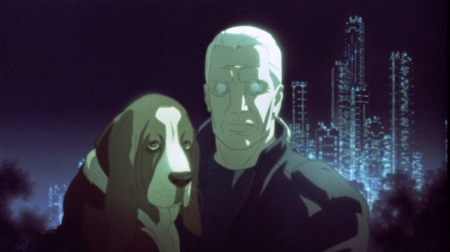
I think part of the reason that people find this so interesting is when there is a highly advanced technological element in a story. We can relate to this because we see parts of that advancement in our own world. We are able to compare how far we have come along in our own "real" technological world, and then possibly even hope for what we may see in the future. It is interesting because even though most of us know that we are rapidly becoming more technologically advanced, we still like to see how far things can be pushed in these animes. In Akira, the government uses complete control over technology and is able to monitor and check almost everything that is going on. Maybe another reason we find situations like that interesting is because some of us are maybe even scared of what our rapid advancement of technology will bring in the future. The argument can then be made whether or not technology is truly helping us or hurting us. There are other movies that use the idea of technology becoming overpowered and taking over as well.
The way Mima's life is being stalked (all by the use of technology) is something that is already seen today. When that film was made, we may not have been as advanced as we are now, which also shows the rate we are moving forward. Even in everyone's personal lives, most of us are somehow connected throughout the internet in some way. As this seems like a good thing, and extremely useful, it could quite possibly result in a large downfall in the distant, or maybe near future.
 Akira, Perfect Blue, and Ghost in the Shell are three great films that contribute to one terrible idea: do we even really know who we are in this world, and do we have any control over our lives anymore? 


I got these images from here, here, here, 
and here.


Friday, February 10, 2012

Herring --- Perfect Blue

In the anime film Perfect Blue, many different issues were brought to light. First of all: materialism and consumerism in society.  The main character of Perfect Blue, Mima, is portrayed as a cutsie teeny-bopper pop idol. Her fan base is obsessed with her pure and sweet image and will do anything to keep her in pristine idol condition. They wait at newsstands and bookstores for any new information on her, like hungry dogs waiting for someone to throw them a hunk of meat. To her fans, Mima is nothing more than a piece of meat, a materialistic object in the eye of the media. They do not care about her personal well-being, they only care for how they can receive satisfaction from her. And if they are dissatisfied with what they get out of her, they cause an uproar. The people only care about what they can reap from Mima’s success, and “consume” it greedily. Another issue was the objectification of women in the media. Mima is constantly in the spotlight of the people; they scrutinize her, judge her, and expect nothing less than perfect from her. Most of the public eye consists of men, men who wish to see her more risqué and mature side. They force more scandalous roles and situation upon Mima because it is what they desire most from her. Men have tasted her sweet and innocent side, and now they are hungry for more. Women in media are (more often than not) seen through the eyes of a man and portrayed as sex symbols and nothing more. Men desire women, and they won’t stop until they get their fill of how they want women to be seen on the big screen. Another thing about Perfect Blue is that the storyline was very similar of that to the movie Black Swan. Both of the main characters were strong and beautiful women who were seen as petite and delicate, yet they had a darker side to them. There were antagonists that led them to believe what they perceived as reality may or may not be true, which led them to a spiraling downfall of confusion and madness. The female roles in Perfect Blue and Black Swan both faced demons in their own ways, and eventually overcame them, in justice and death.

I got that picture from here.

Friday, February 3, 2012

Herring --- Cowboy BeBop


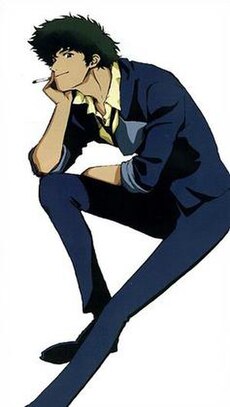
In the movie Cowboy Bebop, it is very obvious that the main character or protagonist is Spike Spiegel.  Although he is the main character and is always surrounded by many different people, there is a feeling that he is constantly alone. Spike seems to have a tendency to distance himself from people around him, to keep himself from getting himself betrayed or hurt. Even though he acts like an abused puppy, Spike is a very caring and tender person. For example, while in the Red Dragon Crime Syndicate, he cared for the new recruits. This shows that, although he may have a cold and untrusting exterior, Spike has a warm, kind center. To reflect further upon his seemingly unlikely kind side, there is a scene where Spike comes across an old woman held at gunpoint by a convenience store robber. Spike had never seen (let alone ever met) this woman before in his life, but he quickly responds to the situation by shooting and killing the robber before the robber can kill the old woman. Spike said that he did not care about the woman at all in the least. But, if he didn’t care, then why did he save her life? That’s one scene where his kindness peeks through his veil of hardass-ness.  Another part from the movie that illustrates the depth of Spike’s “self conflicting” character is his hunt for Vincent. Spike has been told that he doesn’t need to go after the bounty set on Vincent and that there are better bounties to hunt down, but that is not Spike’s concern. Spike is worried about the safety of the citizens on the planet Mars, as well as keeping Elektra from aiding Vincent to regain his memories. Vincent and Elektra’s relationship was romantic, so it hurts Elektra’s feelings that Vincent has basically forgotten their past together. Elektra feels as though she should be the one to destroy Vincent, not Spike. Elektra achieves her goal by shooting the man she once loved and restoring his old state of mind. Spike was able to save the planet of Mars, with the help of his BeBop Crew and Rashid the scientist.  Even though Spike doesn’t want to admit it (for it would be a damper on his lone ranger act), he relies on the help from those who surround him.

I got that lovely picture of Spike right here.

Friday, January 27, 2012

Herring --- Ninja Scroll


About two days ago, I finally got the chance to find a functioning download of “Ninja Scroll”. As I watched the film, looking past the mildly simplistic 1990’s animation, I realized that this movie was more than what meets the eye.

One of the things that I really enjoyed about “Ninja Scroll” was the character development. I like the way that all eight demons were given different themes and skills. Granted, this is something that almost 99% of all animes do, but “Ninja Scroll” managed to do this extremely and surprisingly well. Instead of just normal hand to hand/weapon to weapon combat, every character in the film had something unique about them that aided them in battle.

Each demon was portrayed with a distinct characteristic which made it easy to recognize the characters from one another. Gemma had the ability to reincarnate himself when injured, which made him practically indestructible. Tessai could turn his skin into solid rock when in battle or threatened, almost like a scared porcupine (which adds to his beast-like disposition). Benisato has serpentine qualities, with her ability to shed her skin and control a horde of poisonous snakes. Mushizo is a walking beehive, and Majuro Utsutsu is blind. Shijima can transport himself between shadows and control people’s minds, Yurimaru has the ability to electrocute people, and Zakuro can create explosives in living and dead organisms.
 

As strange as these characters may be, they are a fine example of how unique the creators of this anime got when creating the characters and successfully integrating them into the plot. This anime does a good job in taking characters and giving them distinct personalities, which can be difficult when dealing with a film with numerous main characters. The fact that there are eight different demons all on the same side, the creators had to make sure that each one was unique and completely different from one another. As difficult as it seems, the animators did a superb job of tying together all of the demons.

All in all, I think that “Ninja Scroll” was a fantastic anime and would highly recommend it to those who would like to watch an intense and high-action animated film.

 I got these pictures from here, and here.

Thursday, January 19, 2012

Herring --- Akira


In the Japanese animated film “Akira”, we were bombarded with ideas, representation, and symbolism. As the movie began, the opening scene showed the dropping of a bomb in Japan. This could be possible foreshadowing, setting the mood for the rest of the film. It could also very well be representative of the atomic bombings of Japan during WWII, depicting Japan’s misery and destruction they suffered during the war. But if you had no prior knowledge of this movie, you may perceive it as an introduction of the plotline, of a society being obliterated.
                As the movie goes on, you are introduced to the two main protagonists: Kaneda and Tetsuo. These characters are two rebellious teenage boys that are part of a bosozuko (biker gang), who have grown up in the same orphanage together and have a relationship as though they are brothers. Kaneda plays the role of “big brother”, looking after Tetsuo, making sure he stays out of harm’s way and protecting him when necessary. Tetsuo views their relationship differently. Tetsuo feels as though Kaneda shelters him, treating him like an infant and oppressing his ability to be a strong, powerful leader. Their relationship, although brotherly, is almost like that of an endearing, overprotective father and an angst-filled child who wishes to be viewed as an independent individual. This tension between Kaneda and Tetsuo’s relationship builds as the movie goes on.
                Not long after the introduction, Kaneda and Tetsuo get into a fight with a rival bosozuko which leads to Tetsuo crashing and getting seriously injured. Then suddenly, out of nowhere, the military steps in and ships Tetsuo away. They begin conducting experiments on him and ultimately turn Tetsuo into a human filled with an almost god-like power, if you will.
                I would like to pause for a moment to discuss the moral issues occurring in the plotline so far. The immediate thought I got when watching “Akira” was that the people were like lab-rats, living without purpose and only by instinct, all free will to think was lost, and running on a never-ending wheel of blinded guidance. The hand of the military and scientists reach in and pluck humans from the masses as they please, controlling their every moves and experimenting on them as they see fit. This is completely and utterly immoral. No one is meant to play God, the power is too consuming for any single human being. You cannot take a human being and alter them as you wish, plainly out of greed for knowledge and curiosity. Man is not meant to hold that power, which is why we are called “Men” and not “Gods”.
                Back to Tetsuo and his newly gained powers. Now that the “runt” has been granted with all of the powers he could possibly imagine, he chooses to hold them over Kaneda and those who had oppressed him and get revenge for the humiliation of being viewed as a weakling. As his powers inflate to corruptive levels, Tetsuo’s soul is consumed by the intensity and hatred he is now able unleash. Tetsuo becomes lost within his god-like capabilities and does not realize the damage he has done to everything around him and himself until it’s too late. After getting everything he wanted, Tetsuo begins to panic as he realizes his once beautiful tools of destruction are devouring him and reaches out for those he had feverishly pushed away. Kaneda attempts to save Tetsuo, but these two characters are locked in a battle against an evil that they will realistically never defeat, and only in death will they be released from conflict. Here steps in “Deus ex Machina”: God in the Machine. This simply means that some magical machine (Akira, possibly?) has a god-like presence and saves the almost doomed hero. As Kaneda and Tetsuo slowly realize they are eventually going to die, by the grace of god, a miracle happens: Tetsuo and three other telepathic children are consumed by a blinding white light, and they disappear into the unknown. These characters were meant to die, but for some strange reason, they had been spared.
                Ironically, the beginning and end of this movie are almost exactly alike. These explosions might represent rebirth through destruction, “a phoenix born from the ashes”. Even the scientist at the end of the movie said “Is this…the birth of the universe?” As he said this, a small ball of light fell into Kaneda’s hand and faded away. Could this be representing the birth of a new society? Whatever it means, all we know is that “Akira” ends on a hopeful note, and in a place that is no place, a voice is heard: I am Tetsuo.

I got this image from here.

Thursday, January 12, 2012

Herring --- Introduction

Oh hai!  My name is Ashley Herring, winning over the masses with 350 characters or more.

First of all, I have many different nicknames, so don’t be confused if you hear people call me Ashrey, Ash, or Red. Personally I prefer Red (it’s easier to remember). Also, I may throw you for a loop with my constantly changing hair. I like to dye it frequently and wear extensions, so if you see me one day with long hair and another with short…it’s totally normal.
I was born in Ft. Walton Beach, Florida and lived in Pensacola for a few years as a small child. My father was in the military, so I have moved all across the US. I lived in Florida, Washington, the island of Guam, Iowa, and now Louisiana. Since my father was in the military, he was deployed overseas a lot, mainly to Japan. Because of that, I have had a strong Eastern influence on my life since I was a small child. I was taught to speak Japanese, and could speak it fluently by the time I was about five. Unfortunately, over the years I have forgotten most of the Japanese I had learned. I plan on relearning it as soon as I can.
 I moved to New Orleans from McClelland, Iowa to attend Loyola University. I am currently a Music Industry major. In my spare time I enjoy drawing, reading, watching anime, trolling, destroying n00bs, cow tipping, and underwater basket weaving, among other things. I also like to sing and am currently learning to play the ukulele.
Now it’s time to get down and nerdy. I’m a hardcore gamer, enough said. I am an avid cosplayer, my favorite cosplay character is Rikku from Final Fantasy X-2. I have been attending anime conventions since I was thirteen, and started cosplaying when I was fourteen. I hand sew all of my own costumes because I feel it’s more personal and it’s a great way to learn and understand the character better. I am also a kandy kid aka, a raver. Don’t be appalled if you see me walking around campus in tutus, swimsuits, itty-bitty skirts, furry legwarmers, ears, tails, goggles, or a gasmask: all you need to know is that somewhere out there, a rave is happening.
Well, I hope you enjoyed this short introduction about me.